

We are living in the era of diaspora entrepreneurship. Immigrant founders have established themselves as a global force, strengthening innovation ecosystems well beyond national borders. And nowhere is this more evident than in the United States, where 55% of unicorns were founded by immigrants.
In the age of artificial intelligence, this pattern holds just as strong: 60% of the top US-based AI companies have at least one immigrant founder, according to Forbes.
Far from coincidental, these numbers reflect a structural reality: high-skilled immigration has long been a key driver of American technological leadership, and the entrepreneurial diaspora now stands at the forefront of shaping the future of AI.
Brazil is part of this movement. Long known as a commodity exporter, the country is increasingly asserting itself as an exporter of talent. Entrepreneurs, investors, and tech professionals building and scaling companies across every continent.
To analyze how this phenomenon manifests in the Brazilian context, we launched the first Brazil Tech Diaspora study in 2025. The findings point to a clear thesis: Brazil is no longer confined to its own borders.
A growing network of Brazilian entrepreneurs, investors, and executives in the diaspora is occupying strategic positions in the world’s leading innovation hubs. More than a trend in professional mobility , this presence represents an expansion of the Brazilian ecosystem itself, one that is now connecting to new markets, capital sources, and knowledge networks.
The diaspora entrepreneurs act as bridges in an international context, linking businesses, opportunities, and ecosystems by combining local expertise with global experience.
It is within this context that we developed this analysis focused on the Brazilian diaspora in the United States, a country that remains at the center of global entrepreneurship and is drawing even greater attention amid the rise of artificial intelligence.
Over the past 15 years, venture capital gradually moved away from its US-centric axis — once dominated by Silicon Valley — spreading to hubs like China and India, and later to emerging markets more broadly, including Brazil as Latin America’s leading hotspot.
But 2025 marked a turning point. Fueled by the global race in artificial intelligence, capital has flowed back, once again concentrating in the United States.
of global funding directed to AI companies — $159 billion — went to US-based companies.
of that capital flowed to San Francisco and the Bay Area in California.
Source: Crunchbase, 2025.
Against this backdrop of renewed capital and concentrated innovation, a central question arises: has this shift altered the dynamics for Brazilian entrepreneurs operating in the United States?
• 200+ Brazilians in the diaspora, among entrepreneurs, executives and investors
• 140+ Brazilian diaspora entrepreneurs
• +3.000 VC firms (NVCA)
• 10 Endeavor offices
In the United States, Brazilian entrepreneurs tend to cluster in major innovation hubs, where capital, talent, and entrepreneurship and technology networks converge.
In line with the current venture capital dynamics, the largest share of the diaspora is based in California. More than 200 Brazilians are established in the United States — among them entrepreneurs, executives, and investors — spread across the country’s leading innovation hubs.
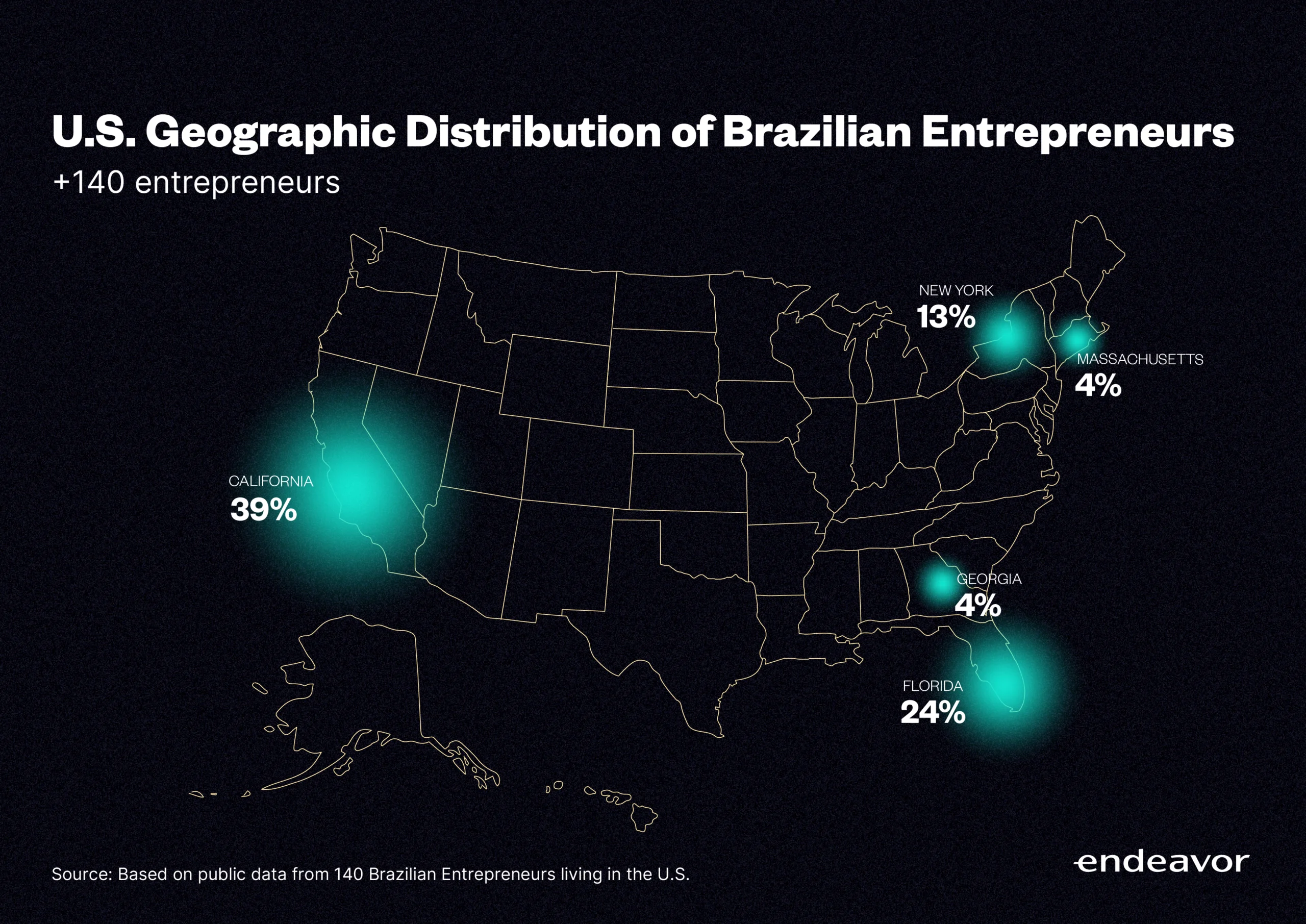
+200 Entrepreneurs, Executives, and Investors
39%
24%
13%
4%
4%

CrewAI
With over 20 years of experience in software engineering, João combines deep technical proficiency across programming languages with strong leadership in building and scaling global teams. He is the founder and CEO of CrewAI, a pioneering Agentic AI platform that enables organizations to create, manage, and scale AI agents across their entire operations

Resend
A prominent open source contributor, Zeno was once ranked among the top 20 most active GitHub users and has spoken at over 110 conferences around the world. Now based in San Francisco, he is the founder and CEO of Resend, where he leads the development of a modern email delivery platform designed to reinvent the way developers integrate and scale email communication.

Openlayer
An entrepreneur and artificial intelligence specialist with a focus on NLP and Machine Learning, Gabriel is the co-founder and CEO of Openlayer, a governance and observability platform that enables teams to test and ensure the reliability of models and agents in production. He leads the development of solutions for the evaluation and monitoring of AI systems.
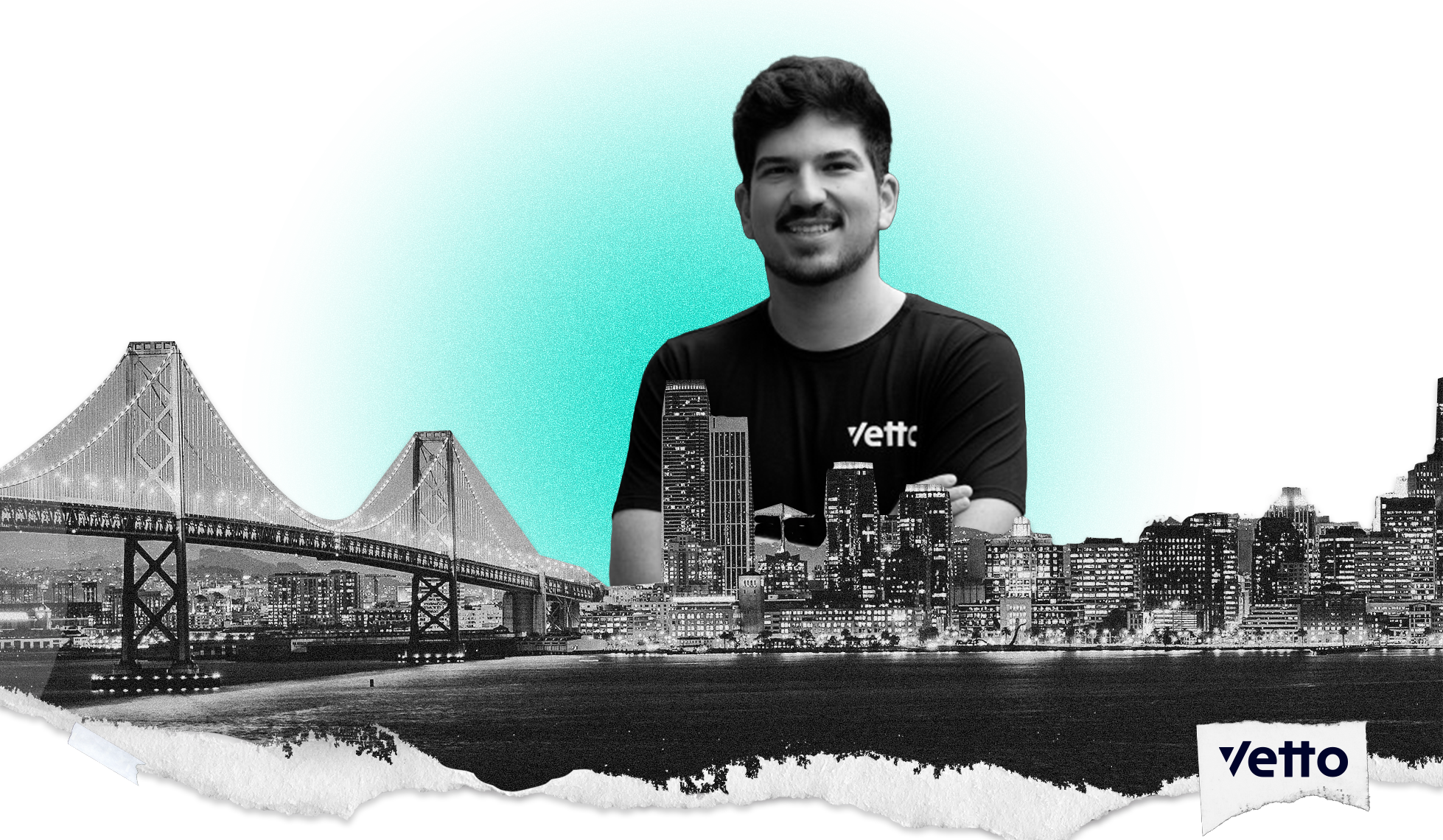
Vetto AI
An entrepreneur focused on data and intelligence for the AI economy, José is the founder of Vetto, a global ecosystem that connects talent and specialists with technology companies, creating opportunities for people around the world to contribute to the advancement of artificial intelligence while generating income, learning, and developing new skills.

Birdie
Alexandre Hadade is a serial entrepreneur with over two decades of experience in marketing, content production, and technology. An Endeavor Entrepreneur since 2007 and now based in California, he is building Birdie, a platform that helps companies turn customer feedback into strategic insight by centralizing data from multiple sources and using AI to surface patterns, validate hypotheses, and enable more informed decisions across product, processes, and customer experience.

Birdie
Born in Minas Gerais, Marco built a global trajectory shaped by a decade in China and experiences across Hollywood and Silicon Valley. Now based in San Francisco, he is an Endeavor Entrepreneur since 2014 and the CEO of HeadOffice.ai, where he develops AI agents with personality and empathy, designed to anticipate human needs and build meaningful relationships. HeadOffice.ai is Brazil’s leading AI-first platform, integrating customer service, sales, HR, project management, CRM, and contact management into a single secure, no-code solution.

MUSIC.AI
A serial entrepreneur and software developer, Geraldo is the co-founder and CEO of Music.AI, a company building an AI-powered audio platform with over 50 integrable solutions, more than 16,000 active accounts, and a user base exceeding 48 million. The platform processes over 2 million minutes of audio per day, serving clients ranging from record labels and agencies to technology companies.

Founder and CEO of Wellhub, Endeavor Brazil Board
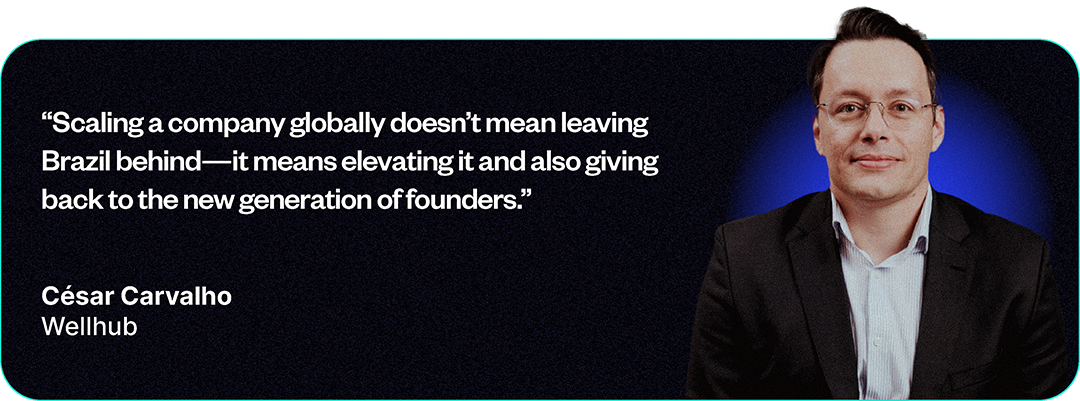
Cesar moved to New York with a clear objective: to accelerate Wellhub’s global expansion.
“The market is so large that it can seem advantageous to operate exclusively within Brazil and never expand internationally. But that’s not always true.”
New York made it easier to recruit world-class talent, secure international investments, and reshape external perceptions. However, Cesar admits that being underestimated is a common challenge for Latin American founders.
“From an investor’s perspective, there is a lack of examples of entrepreneurs and companies from LATAM building businesses in the United States and Europe. Having more success stories increases the investor appetite for such ventures.”
As more Brazilian-founded companies expand globally, investors are starting to recognize the untapped potential in Latin America.
“As the world becomes increasingly uncertain, Brazilian founders have the advantage of navigating through turbulent times.”
Wellhub expanded to 11 countries, with the U.S. representing a significant share of revenue. Despite its international success, Cesar remains deeply connected to his Brazilian roots, investing and mentoring entrepreneurs.

Co-founder and CEO of VTEX
Mariano relocated to London to position VTEX as a global leader in e-commerce.
Founded in 2000, VTEX had seen significant growth in Brazil, but Mariano couldn’t wait for full consolidation at home: in 2012, VTEX began expanding into Argentina, Colombia, Chile, and Peru.
“I do not believe in the argument that Brazil needs to be conquered first.”
By 2016, the time had come for the U.S. Relocating VTEX’s headquarters from Miami to New York paid off: in 2021, VTEX went public on the NYSE, successfully delivering on all its IPO commitments.
“The European and American markets still see Latin America as a commodity hub, not a tech ecosystem. We had to prove otherwise.”
Mariano reflects on giveback. For him, financial contributions come first, not time.
VTEX’s playbook is also open and accessible to the public to inspire other entrepreneurs. For Mariano, this is just the beginning.
“If we succeed, we’ll have built a brand that paves the way for 10 more companies. We’ll have transformed Brazil’s global perception—establishing “Made in Brazil” and “Engineered in Brazil” as hallmarks of quality.”
Miami has evolved from a retiree destination into a fast-growing innovation hub, with no state income tax and strong ties to Latin America. Nearshore outsourcing and a growing investor ecosystem make Florida a compelling option, especially for those focused on regional expansion while maintaining close connections to Brazil.

Invisto | i4 Capital Group | SellersFi | Digibee
Businesses led by Brazilians remain heavily concentrated in categories where technology operates in a structural and scalable way.
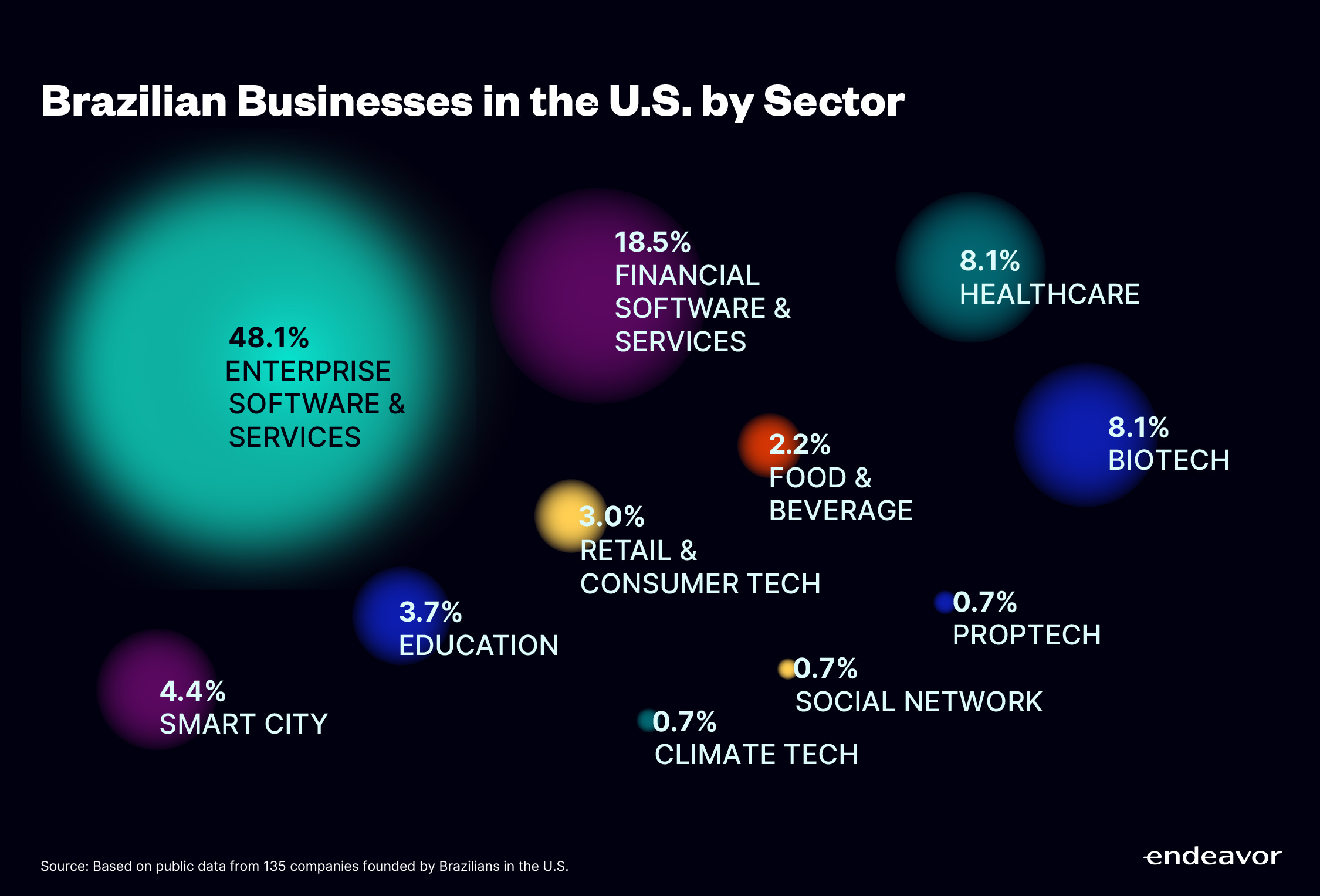
This suggests that the Brazilian diaspora has exported expertise developed in sectors where the country has already built competitive depth, especially in enterprise software and financial services.
At the same time, new ground is being gained in areas more directly shaped by emerging waves of innovation, such as Healthcare, where cases like Wellhub illustrate how solutions conceived in Brazil can evolve to meet global demand, combining corporate wellness, digital platforms, and new applications of artificial intelligence.
Brazilian entrepreneurs are now building companies across the world’s leading technology ecosystems, increasingly centered on the application of artificial intelligence.
In this new technological cycle, the rise of companies built with artificial intelligence at the core of their business model points to a new frontier of opportunity for Brazilian entrepreneurs building global companies. It expands their ability to compete in emerging categories and capture value in markets increasingly driven by technology.
This shift is already reflected in where AI adoption is gaining the most traction — with a clear concentration in sectors that combine scale, complexity, and high potential for transformation.
Enterprise Software & Services
Financial Software & Services
Healthcare
Brazil still plays a more prominent role in the early stages of the funding journey, but its presence weakens as rounds advance.
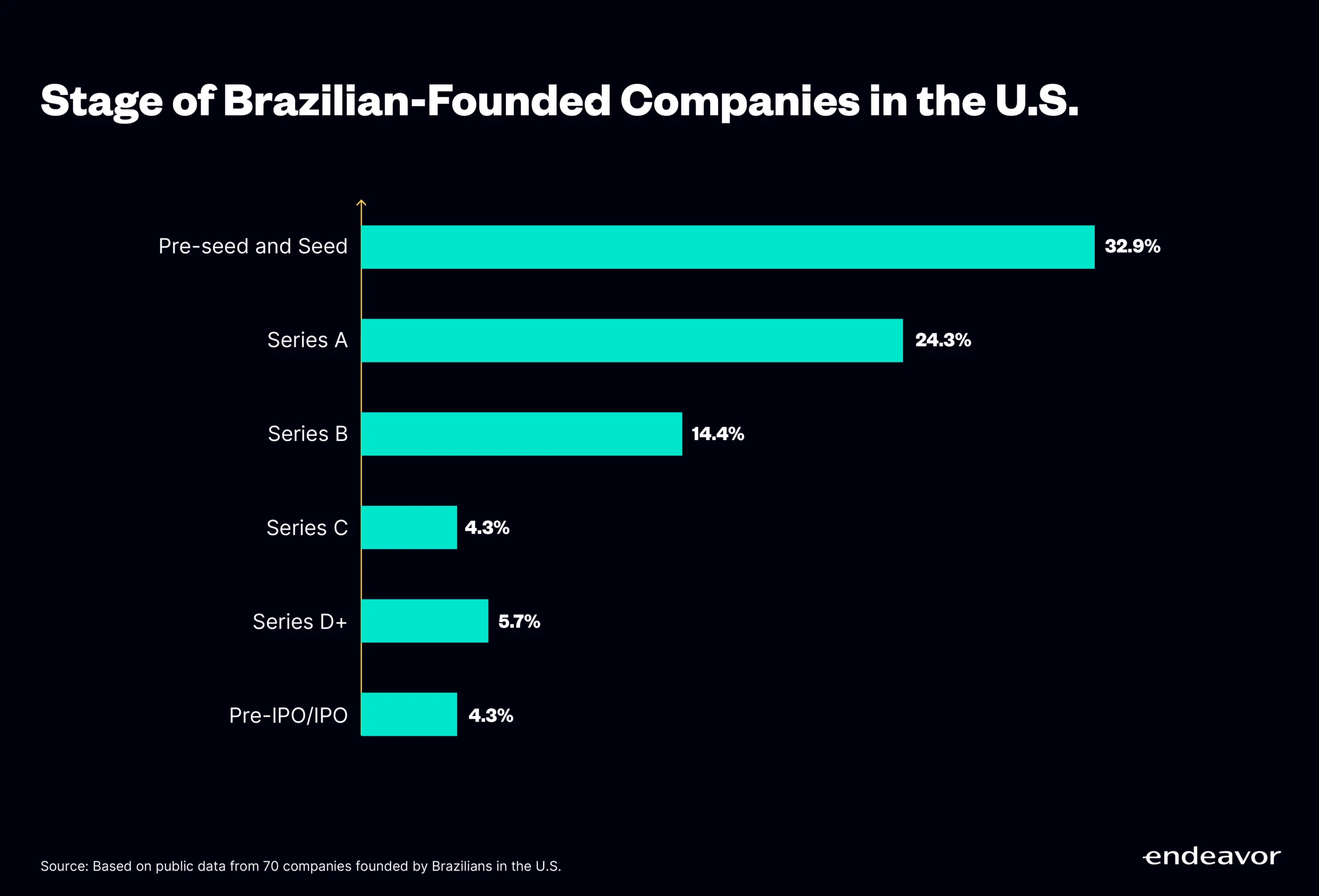
The pattern suggests that while Brazil is already able to participate in the formation of these trajectories, there is still room to build greater traction as the game shifts toward scale, growth capital, and more consistent access to larger rounds.
Among the companies mapped in this analysis, the average capital raised reaches $218 million, while the median stands at just $25 million. This gap reveals a strong concentration: although the U.S. ecosystem enables access to large volumes of investment, it is a small number of outliers that pull the average upward, including companies like Brex, Wellhub, VTEX, YipitData, and SellersFi.
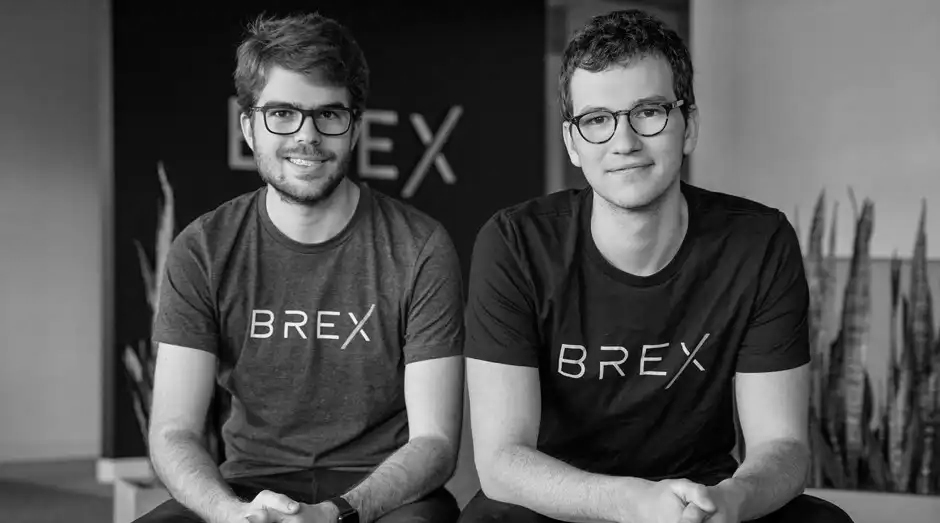
The Brex story illustrates the scale potential achieved by Brazilian entrepreneurs embedded in the U.S. ecosystem. Founded by Endeavor Entrepreneur Henrique Dubugras and by Pedro Franceschi, the company built a corporate financial management software platform that integrates artificial intelligence into its processes, bringing together corporate cards, automated expense control, and real-time payments into a single system.
In 2025, Brex was acquired by Capital One for $5.15 billion, in a transaction split evenly between cash and stock. A milestone that reinforces the ability of Brazilian entrepreneurs to build large-scale companies from the United States.
The Brazilian diaspora remains closely connected to Brazil and actively contributes to the local ecosystem, forming a strong community built on trust and mutual support. Even from a distance, these entrepreneurs help strengthen the Brazilian ecosystem by investing, mentoring, sharing knowledge, and opening doors.
This exchange fosters a global community defined by trust and collaboration. More than a group scattered around the world, the Brazilian diaspora is a strategic asset in driving the growth of Brazil’s scale-ups.

Institutional support:

Authors
Karina Almeida
External Relations Manager
Daniella Quelho e Correa de Mello
Director of Marketing & External Relations
Iana Maria da Hora
Research & Content Associate
Juan Perroni
Brand Strategist
About Endeavor Brazil
We are the Global Network of Trust of, by, and for entrepreneurs — those who dream bigger, scale faster, and reinvest their success. Guided by our belief that high-impact entrepreneurs transform economies, Endeavor has been building thriving entrepreneurial ecosystems in emerging and underserved markets since 1997. In Brazil, our mission is to consolidate the country among the world’s leading innovation ecosystems.
Endeavor Brazil’s Research contributes to this ambition by generating data-driven insights and practical case studies on the drivers of the Brazilian entrepreneurial ecosystem. Leveraging Endeavor’s footprint, our studies explore the conditions that foster high-growth entrepreneurship, equipping founders and ecosystem leaders with the knowledge to scale companies and strengthen Brazil’s innovation landscape.
For more information, contact karina.almeida@endeavor.org.br